

Age of Information (AoI) measures how fresh the information at a receiver is. At any moment t, the age is Δ(t) = t − u(t), where u(t) is the generation time of the newest update the receiver has. If the latest sensor reading on a dashboard was taken four seconds ago, the age is four seconds, and it keeps growing until a newer reading arrives.
That makes it different from latency, which is the delay of each individual packet, and from throughput, which counts how many packets get through. You can do badly on age in two opposite ways: send updates too rarely and the receiver is left holding old information; send them so often that queues build up, and every update is already stale by the time it arrives.
How old is your data?#
Data timeliness is one of the six criteria I identified while working at Methanex NZ, and the idea behind it is simple: new information is worth much more than old. Recently, researchers have been proposing algorithms that schedule data collection from sensors and IoT devices so as to minimise the Age of Information in next-generation (5G) wireless networks.
Data quality#
I researched data quality during my time at Methanex NZ, and these were the key points I identified for judging the quality of data:
- Timeliness: how much value the data still has at the moment it’s used.
- Completeness: how much of the data is in the system, with no missing fields.
- Consistency: how well the data is kept consistent.
- Confidence: how far you can trust the source of the data.
- Accuracy: how well the data represents reality.
- Integrity: the number of sources, and how consistent the data is across them.
Welcome to the age of data.#
Age of Information#
Age of Information is about the freshness of data [1]. Interest in it has grown with the move from 4G to 5G, which puts far more weight on wireless service for Internet of Things (IoT) devices and machine-type communication (MTC) [2].
The key ideas: the sawtooth, average age and peak age#
Plot the age over time and you get a sawtooth. Between updates it climbs steadily, one second of age per second. When a new update arrives the age drops, but not to zero: it drops to the time that update spent in transit, because it was already that old when it landed.
Two numbers summarise the curve. Average AoI is the area under the sawtooth divided by the time observed, so it’s the age you’d see at a random moment. Peak AoI is the average height of the teeth, the age just before each update lands, which is easier to analyse and tells you how stale things get at worst in a typical cycle.
The classic early result comes from Kaul, Yates and Gruteser’s 2012 paper, “Real-time status: How often should one update?” [4]. They modelled updates passing through a single first-come-first-served queue (M/M/1), with service rate μ and utilisation ρ (how busy the link is), and showed that the average age is
Δ = (1/μ) × (1 + 1/ρ + ρ² / (1 − ρ))The 1/ρ term punishes sending too rarely, and the ρ²/(1 − ρ) term punishes sending so much that a queue builds up. Age is lowest at ρ ≈ 0.53, with the link idle almost half the time. Maximising throughput would push ρ towards 1, and minimising the delay of each packet would push it towards 0; freshness wants neither. That is the whole case for the metric in one line: the best update rate for freshness is one that neither throughput nor delay would choose.
Two papers on scheduling for AoI#
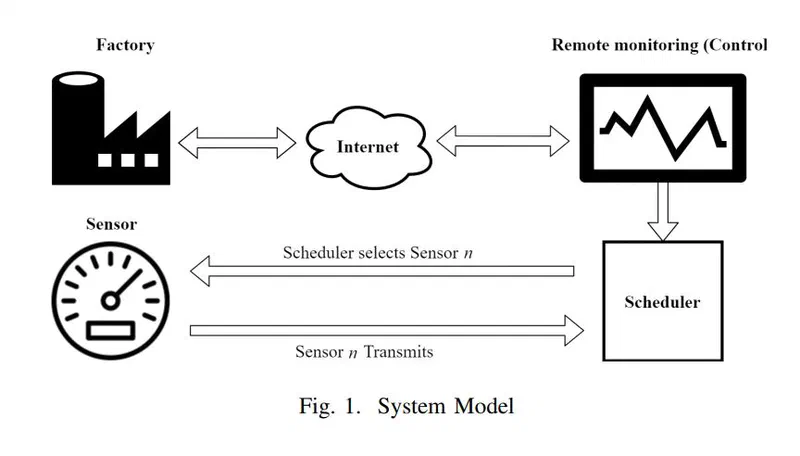
The authors consider a factory where a number of sensors constantly transmit data about their current state. The sensors have no on-device storage, so a sensor’s present state is only recorded if the remote scheduler selects its signal; the scheduler’s access point ignores the rest. That leaves the scheduler with a dilemma: how to choose among sensors with different thresholds and packet sizes so that none of their timing requirements are violated. “The URLLC term minimization is represented by ensuring that the probability the AoI of each sensor exceeds a predefined threshold should be at its minimum.” To solve this formulation, they train a reinforcement learning scheduler with an actor-critic algorithm.
Minimizing the Age of Information from Sensors with Correlated Observations [3]
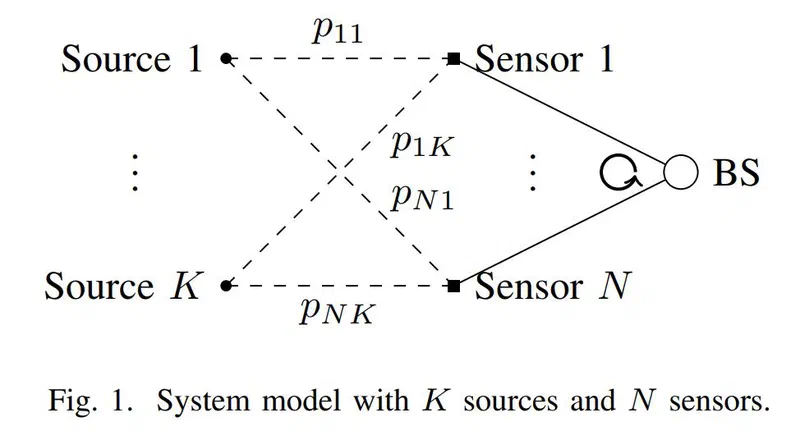
This paper studies “the average AoI in a generic setting with correlated sensor information.” Each update from a physical source can be picked up by several sensors, so their observations overlap, and there’s no point in the access point collecting the same update twice. The authors propose two scheduling policies: one that needs the system’s parameters to be known in advance, and one based on contextual bandits that learns them as it goes. Both exploit the overlap between sensors to cut the age by a wide margin compared with random or round-robin schedules.
References#
Further reading: the best place to start is the survey by Yates, Sun, Brown, Kaul, Modiano and Ulukus, “Age of Information: An Introduction and Survey” (IEEE Journal on Selected Areas in Communications, 39(5), 2021). For a whole book on the subject, there’s Age of Information: Foundations and Applications, edited by Pappas, Abd-Elmagid, Zhou, Saad and Dhillon (Cambridge University Press, 2023).