

A UAV network is a wireless network in which drones (unmanned aerial vehicles) take part in one of two ways. Either they fly as aerial base stations or relays, bringing coverage and capacity to places the ground network can’t reach or can’t keep up with, or they are aerial users, connected to the cellular network much like a phone, that the network has to serve in three dimensions.
Background#
Since affordable drones arrived, the number of people using them has kept climbing, mostly because they’re highly mobile and can do jobs in the air that are awkward to do any other way. With 5G just around the corner, researchers are looking for better ways to place drones, both in the air and on the ground between flights. Get the placement right and cellular connectivity improves, and the average latency between aerial user equipment and equipment on the ground comes down.
A Tutorial on UAVs for Wireless Networks: Applications, Challenges, and Open Problems#
Types of UAVs#
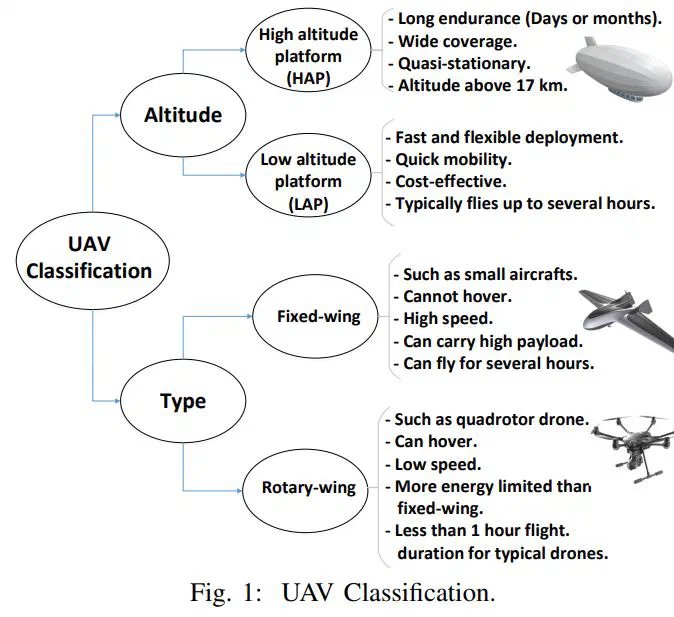
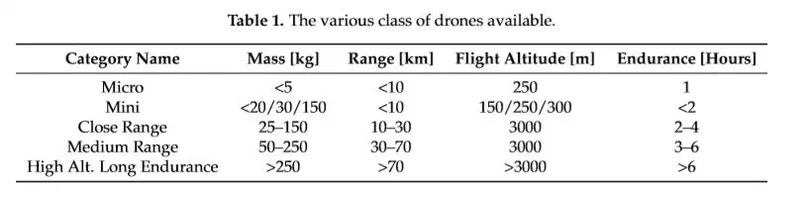
Paper [1] sorts UAVs into a tree that branches out into sub-classes.
Beyond 5G with UAVs: Foundations of a 3D Wireless Cellular Network#
Introduction#
- Drones in large numbers will have a big effect on wireless networks.
- Applications include thermal imaging, package delivery and aerial base stations.
- The paper looks at low-altitude drone user equipment in a 3D space, served by access points on high-altitude platforms, which are UAVs such as blimps.
Background#
- Earlier work ignored drones that are themselves user equipment (UE) in flight.
- Earlier work on user association in drone networks didn’t consider aerial base stations.
System Model#
- Two kinds of drone: high-altitude drones act as access points for low-altitude drone UEs.
Transport Theory#
 - The authors use optimal transport theory to decide which aerial base station each drone UE connects to. In their simulations it cut average latency by up to 46% compared with classical SINR-based association.My Contribution#
Facility Location Problem Approach for Distributed Drones#
The paper starts from two gaps: governments and aviation agencies are bound to restrict where drones can take off and land, and most drone research assumes where a drone starts without justifying it. We proposed drone ports, fixed places for drones to take off, land and charge, and an algorithm derived from the facility location problem that picks them from a set of candidate sites to minimise the average distance drones travel to the tasks in an area. It gives a near-optimal placement that reduces the drones’ overall energy use. We then applied several travelling salesman algorithms to find the shortest route for a drone to visit all its tasks.
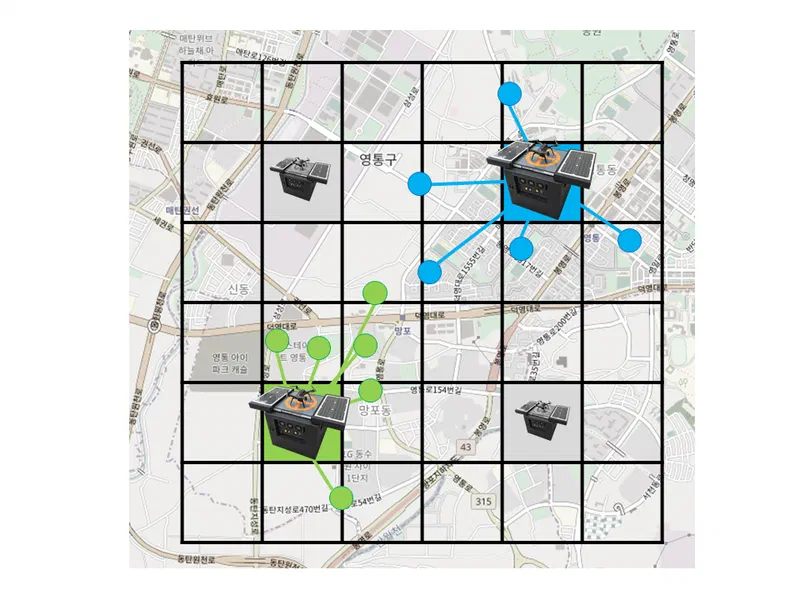
The figure above shows the idea: put drone ports where demand is high. The larger coloured ports are the ones chosen as optimal, and the smaller greyed-out ones are candidate locations that didn’t make the cut.
Facility Location Problem#
Framing it as a facility location problem turns drone port placement into an optimisation problem: given a budget and a set of candidate locations, find the best places to put the ports.