

Every B2B SaaS runs into the tenancy question eventually, usually the day a big prospective customer asks whether their data can live somewhere separate from everyone else’s. I’ve been near this conversation at more than one company now, and the answer always comes down to two options: give each customer their own instance (single-tenant, multi-instance), or run everyone on one shared instance (multi-tenant, single-instance). Neither is “correct”. They just fail in different ways.
Infrastructure Design#
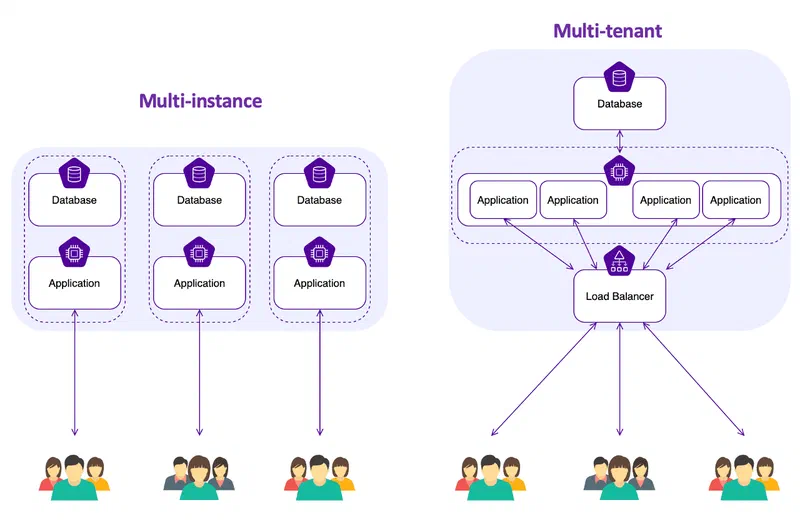
Single tenant, multi-instance#
The appeal here is isolation, and nearly every benefit flows from it. Each customer’s data sits in its own environment, so security reviews and compliance conversations get a lot easier. A bad deploy or a heavy workload takes down one customer instead of all of them. You can scale, tune, and customise each instance independently, and dedicated resources mean nobody’s performance depends on what a neighbouring tenant is doing. Maintenance can be scheduled per customer, which keeps downtime small and targeted, and if you price things sensibly you can match infrastructure cost to what each tenant actually uses.
The price you pay is that you’re now running N copies of everything. Resource overhead adds up, configuration drifts between instances, and keeping versions and data in sync across the fleet becomes its own project. Scaling, isolation, and cost management still need real planning. The problems don’t disappear; they multiply.
Multi tenant, single instance#
This is the default for a reason: one deployment, one database to back up, one version in production. It’s efficient with resources, simple to operate, and every customer gets updates and security patches at the same moment.
The hard parts are the flip side of sharing. One tenant’s heavy usage can drag down everyone’s performance, per-customer customisation is limited, and data isolation now lives in your application code rather than your infrastructure, so a single bug can turn into a cross-tenant data leak. Scalability bottlenecks hit all customers at once, and maintenance needs more care because there’s no “just this customer” blast radius anymore.
Learn more about SaaS Solutions - Multi-instance vs. Multi-tenant Architectures
Where to start for single-tenant?#
If you do go single-tenant, tooling decides whether it’s manageable or a slow-motion disaster. You can’t hand-manage thirty environments.
The core is containers plus infrastructure as code. Docker packages the app identically for every tenant, Kubernetes handles deploying and scaling all those instances, and Terraform, Pulumi, or AWS CloudFormation let you define a tenant’s entire stack in code, so spinning up customer #31 is a pull request rather than a lost weekend. If you’re living closer to the VM world, configuration management tools like Ansible, Chef, or Puppet fill the same role. A solid CI/CD pipeline (Jenkins, GitLab CI/CD) matters more than usual here, because every release has to roll out across every instance without babysitting.
Beyond that, it depends on your product’s shape. Serverless (AWS Lambda, Azure Functions) can remove the server layer entirely for some workloads. Managed databases like Amazon RDS or Azure SQL Database save you from administering one database per tenant by hand. Monitoring with Prometheus, Grafana, or New Relic stops being optional once you have a fleet, because you want to know which instance is unhappy before the customer tells you. For identity, a service like Auth0 or Okta handles user management and access control without you rebuilding it per tenant. Whatever language you work in, there’s probably a SaaS-oriented framework or library that saves you some of this plumbing, and any of the big clouds (AWS, Azure, Google Cloud Platform) will host all of it happily.
Don’t buy the whole list on day one. Start with containers and IaC, add monitoring and IAM as tenants accumulate, and let actual pain drive the rest.